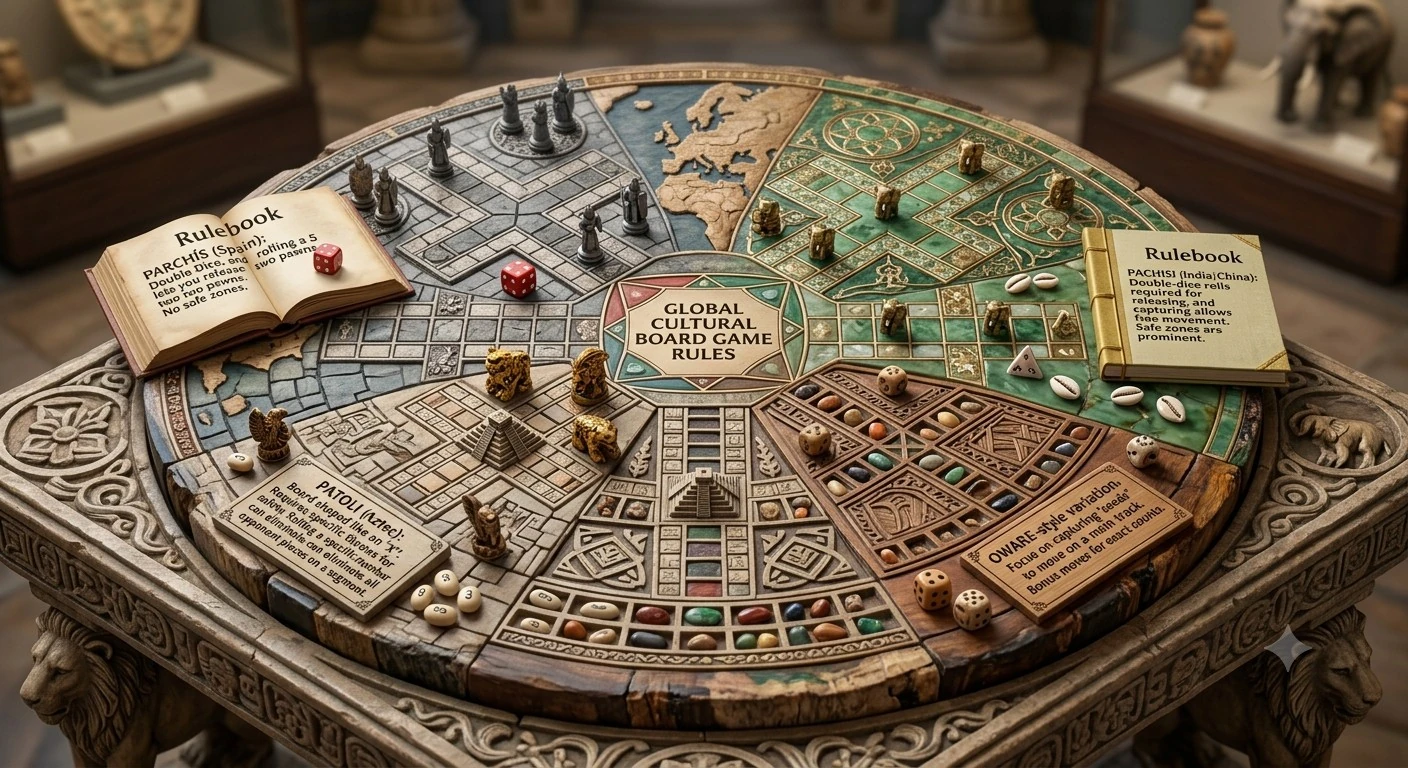
Cultural Differences in Board Game Rules Worldwide
If you've ever sat down to play a game of Ludo with a group of friends from different parts of the world—or even just different parts of the same country—you've likely experienced the "House Rules" argument. It usually happens about five minutes into the game. Someone rolls a six, moves a token onto an occupied square, and chaos ensues. "Wait, you can't capture my token here, it's a safe zone!" "What are you talking about? That's not a star tile!"
These arguments are a testament to the incredible global journey of cross-and-circle games. What started as the ancient Indian game of Pachisi has evolved over centuries, traveling across continents and fragmenting into dozens of regional variations. Today, we're exploring the fascinating cultural differences in board game rules and how we managed to unify them for Jungle Dice.
The 'House Rules' Phenomenon
Almost every family has their own specific set of 'house rules', but if you zoom out, these variations actually follow distinct geographical and cultural patterns. The rules of a simple board game often reflect the cultural values of the region that plays it.
For example, in many South American variations (often called Parqués), the game is fiercely aggressive. Landing on a star tile doesn't just make you safe; sometimes it allows you to literally "jump" to the next star tile, accelerating the pace of the game. Capturing an opponent's token is heavily incentivized, sometimes rewarding the capturing player with massive movement bonuses. The culture dictates a fast, high-stakes, ruthless game.
Conversely, in parts of Northern Europe, variations of the game tend to lean heavily into defensive strategy and fairness. In some regional rules, forming a blockade (placing two of your tokens on the same square) is strictly forbidden, as it's seen as an unfair stalling tactic. In others, you literally cannot capture an opponent's token if they are on a colored tile. The emphasis is less on destroying your enemies and more on running a clean, efficient race to the finish line.
The Blockade Debate
Perhaps the most hotly debated rule worldwide is the concept of the blockade. In traditional Indian Ludo, blockades are a core strategic element. If you manage to get two tokens on the same tile, they form an impenetrable wall. No one—not even your own other tokens—can pass them until you choose to break the wall. It’s a brilliant mechanic for controlling the board and forcing opponents to waste good rolls.
However, if you take that same mechanic to the United States (where the game is often known as Parcheesi), the rules surrounding blockades are often entirely different. Sometimes blockades can be jumped over with a specific dice roll, or they can only be maintained for a maximum of three turns. The cultural tolerance for "stalling" dictates the rulebook.
Standardizing for a Digital World
When we set out to build Jungle Dice, we faced a massive challenge: how do you build a global multiplayer game when everyone in the world thinks *their* rules are the only correct rules? If a player from Mumbai matches against a player from Bogota, whose rules do they use?
We knew we had to standardize the mechanics to ensure fair, competitive, global matchmaking. We couldn't just adopt one region's rules and alienate the rest. Instead, we spent months playtesting different variations to find the perfect balance between aggressive capturing and defensive board control.
Our solution for Jungle Dice was to standardize the classic safe zones (the star tiles) to provide necessary defense, but we stripped away overly complex blockade rules to keep the game moving at a lightning-fast pace. Furthermore, because Jungle Dice is a timed, score-based game, the win conditions naturally dictate the strategy. You don't need a rule telling you to be aggressive; the ticking clock does that for you.
We also incorporated our own unique, globally-understood mechanics, like the Mega Draw, to give everyone a fresh, level playing field. While you might miss your specific childhood house rules, we've found that standardizing the chaos creates a fiercely competitive environment where skill—not geographical location—determines the winner.
So why wait? Let's get playing Jungle Dice and make some people take notice!
Play a game of Jungle Dice and shock the world!
Play Jungle Dice