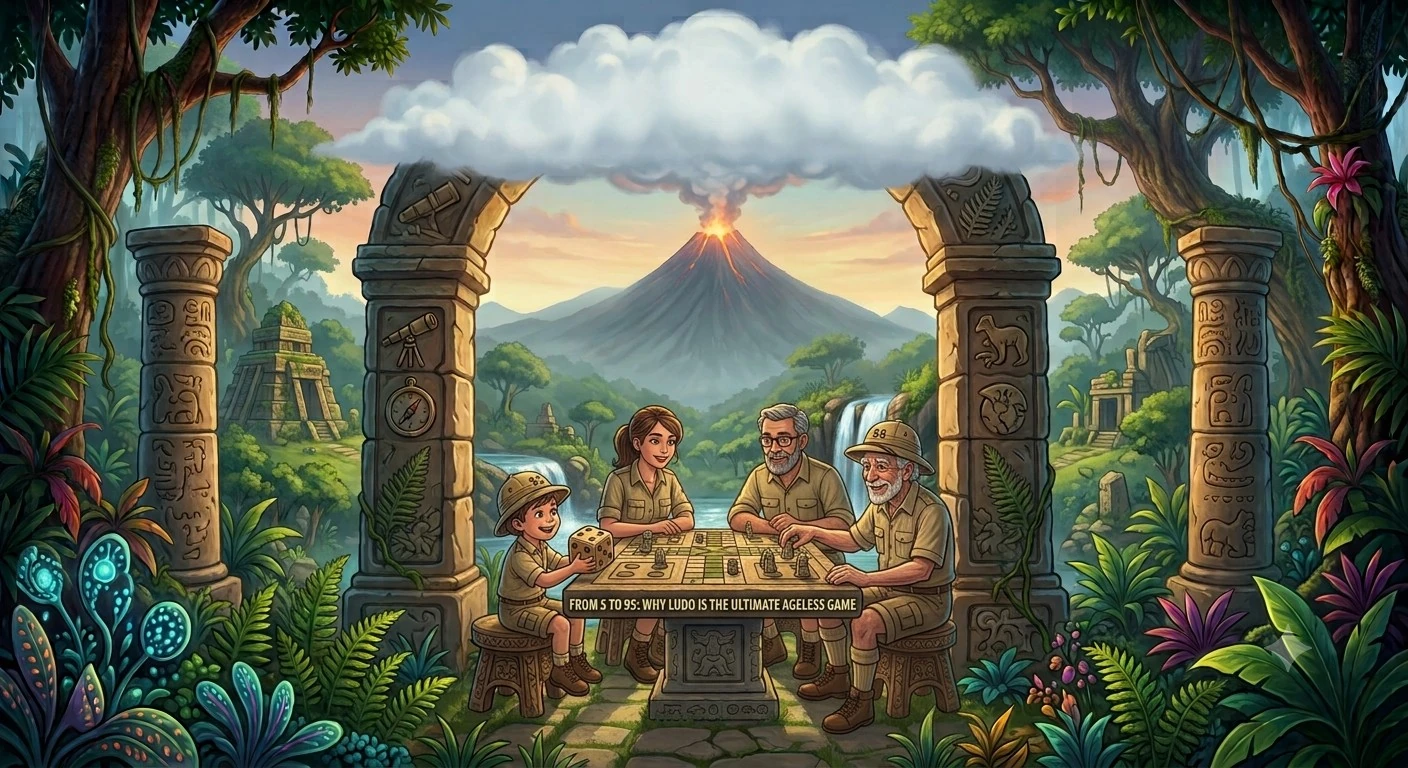
From 5 to 95: Why Ludo is the Ultimate Ageless Game
Think about the video games that are currently popular. A fast-paced shooter requires the twitch reflexes of a teenager. A massive strategy game requires hours of reading tutorials, alienating anyone without a lot of free time. A hyper-casual tapping game might keep a toddler occupied, but it will bore an adult to tears in three minutes. Finding a game that an entire family—from a kindergartener to a great-grandparent—can play together and genuinely enjoy is like finding a unicorn.
Yet, Ludo has been doing exactly this for centuries. It is the great equalizer of the gaming world. Whether you are playing on a dusty cardboard mat or logging into a high-stakes digital match on Jungle Dice, the appeal remains universal. Let's break down exactly why this simple game transcends age barriers like nothing else.
The Dual-Layered Genius
The true genius of Ludo lies in its dual-layered design. If you observe a five-year-old playing the game, they aren't thinking about board control or safe zones. For them, the game is a vibrant, exciting exercise in basic mechanics: rolling a die, recognizing the number, and moving a brightly colored piece that many spaces forward. It's simple, visual, and provides immediate feedback.
However, if you put that same board in front of a group of competitive adults, the game transforms. The simple act of moving a token becomes a high-stakes calculation. Players are suddenly assessing probability ("What are the odds they roll a 4 to capture me?"), managing risk ("Should I move my leading token closer to home, or bring a new token out of the base?"), and engaging in psychological warfare. The game scales perfectly to the cognitive ability of the person playing it.
The Great Equalizer: The Dice
In chess, a Grandmaster will beat a novice 100 times out of 100. The skill gap is insurmountable. In Ludo, because of the inherent randomness of the dice (a topic we explore deeply in our Skill vs Luck article), the playing field is radically leveled.
A five-year-old genuinely has a mathematical chance to defeat a ninety-five-year-old veteran. This element of chance prevents the game from feeling punishing or elitist. When the child wins, they feel a massive surge of accomplishment. When the adult loses, they can shrug it off with a smile, blaming the dice rather than their own intellect. This dynamic makes Ludo the ultimate tool for multi-generational bonding. It removes the stress of pure competition and replaces it with shared, chaotic fun.
Translating to the Digital Age
When we developed Jungle Dice, preserving this ageless appeal was our top priority. We knew we were introducing modern, competitive features like timed matches and score-based victory conditions. But we also knew that if we made the interface too complicated, we would alienate a huge portion of the global player base.
That's why Jungle Dice features a clean, hyper-intuitive UI. Large, distinct tokens, clear animations, and a massive, satisfying dice-rolling mechanic ensure that anyone who can tap a screen can play the game. Even our advanced features, like joining a Clan, are designed to be accessible to older generations who might not be familiar with traditional gaming guilds.
In a world that feels increasingly segmented by age, technology, and interests, Ludo remains a rare, unifying force. It proves that sometimes, the best way to bring people together isn't with a complex new invention, but with a six-sided die and a race to the center of the board.
So why wait? Let's get playing Jungle Dice and make some people take notice!
Play a game of Jungle Dice and shock the world!
Play Jungle Dice