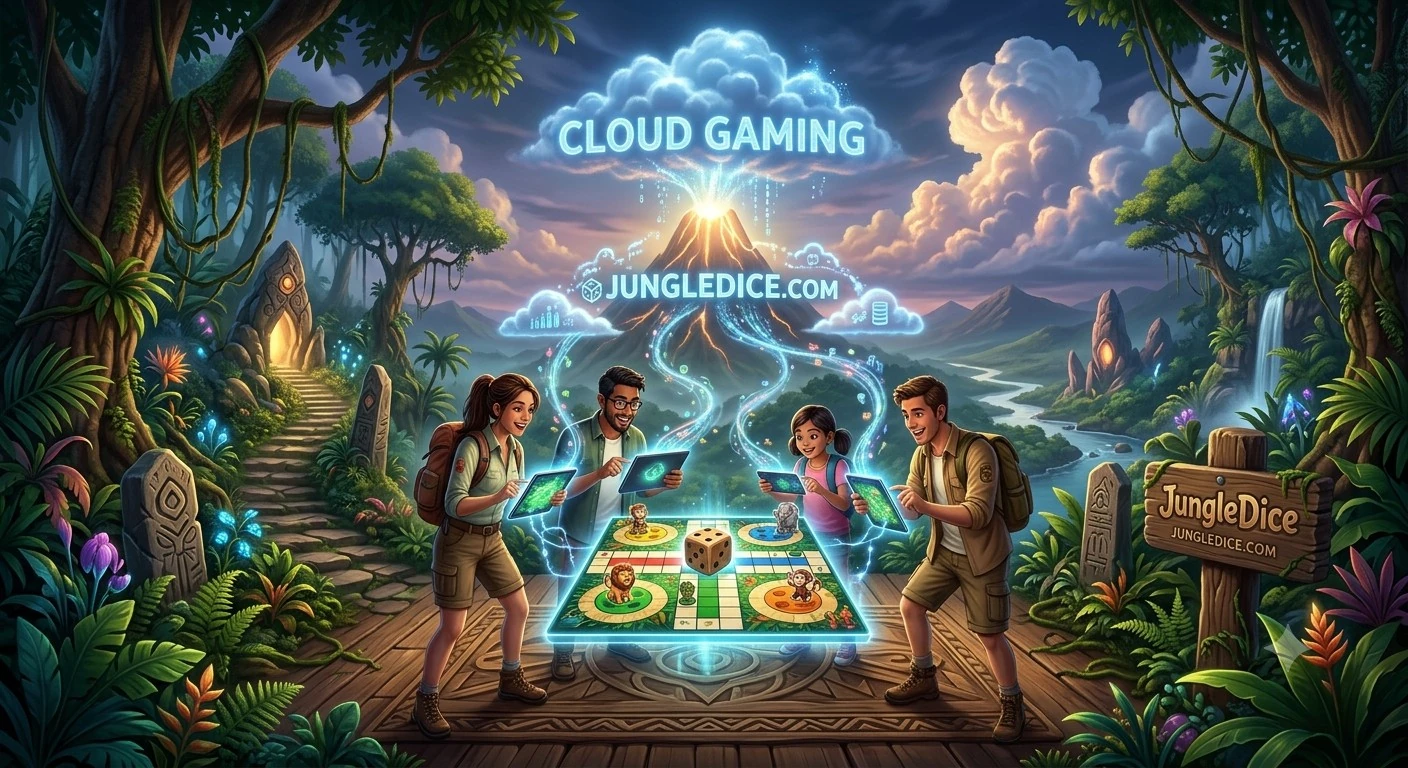
The Rise of Cloud Gaming: How 5G is Changing Latency
If you have been playing multiplayer games for more than a decade, you know the universal sign of defeat. It's not a bad dice roll. It's not getting outplayed by your opponent. It's the dreaded "Connecting to Server..." message popping up in the middle of a crucial turn. For the longest time, the quality of a multiplayer game was entirely dependent on the physical copper wires running into your house.
But the landscape of mobile gaming is currently undergoing a massive, invisible structural shift. The combination of cloud computing and the global rollout of 5G infrastructure is fundamentally rewriting the rules of latency, and it is the exact reason why games like Jungle Dice can now support millions of concurrent players flawlessly.
The End of the "Host Advantage"
In the early days of online gaming, matches were often hosted on a peer-to-peer network. One player's device acted as the "host" server. If the host had a bad internet connection, everyone in the lobby suffered. If you were playing against the host, they had an inherent "ping advantage," meaning their actions registered fractions of a second faster than yours. In a high-stakes, timed game, that advantage was insurmountable.
Cloud gaming completely eliminates this issue. Today, when you play a match of Jungle Dice, neither you nor your opponent is hosting the game. The match is being calculated and verified on a neutral, hyper-powerful cloud server, often located in an AWS or Google Cloud data center precisely positioned between the two players. This ensures a perfectly level playing field, where the only thing determining the winner is skill (and a bit of luck from the dice).
The Magic of 5G Infrastructure
However, cloud servers are only half of the equation. The server still has to send that data to your phone. Historically, cellular networks (3G and early 4G) were simply too slow and unreliable for real-time competitive gaming. You couldn't play a timed tournament match on the bus because your signal would drop for a second, and you would lose your turn.
The global rollout of 5G infrastructure has changed everything. 5G doesn't just offer faster download speeds; its primary innovation is drastically reduced latency (the time it takes for data to travel from your phone to the server and back). With 5G, data transmission speeds are now rivaling, and in some cases exceeding, wired home broadband connections. You can now experience single-digit millisecond ping while sitting in a park.
Powering the Jungle Dice Architecture
This incredible cellular infrastructure is what allows the React and Node.js backend of Jungle Dice to function so flawlessly. When you tap to roll the dice, that signal is sent to the cloud, verified by our anti-cheat algorithms, and beamed back to both players' screens in under 50 milliseconds.
This allows us to implement highly competitive, fast-paced modes like Score-Based Ludo, where every single second counts. We can confidently host massive seasonal tournaments with earnings on the line, knowing that the players will not be cheated out of a victory by a random lag spike. Cloud computing and 5G have finally fulfilled the promise of mobile gaming: a true, uncompromised, console-quality competitive experience, available instantly, anywhere in the world.
So why wait? Let's get playing Jungle Dice and make some people take notice!
Play a game of Jungle Dice and shock the world!
Play Jungle Dice