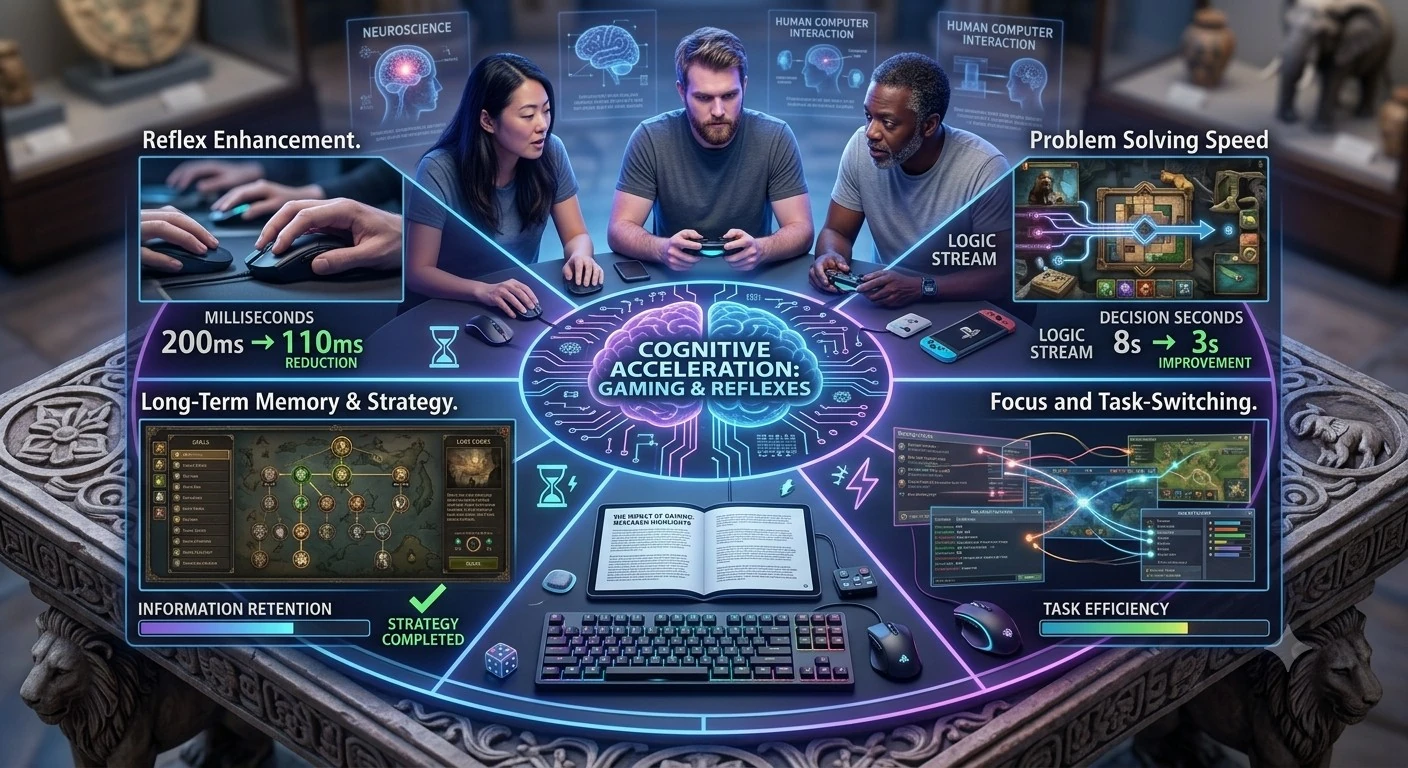
The Impact of Gaming on Reflexes and Cognitive Speed
For decades, video games were often dismissed by critics as a mindless activity that turned players into couch potatoes. However, modern neurological research has completely flipped that narrative. We now know that engaging in fast-paced, decision-heavy gaming is essentially a high-intensity workout for your brain. Whether you are playing a first-person shooter or navigating the intense late-game stages of a Jungle Dice match, the impact on your cognitive speed and physical reflexes is profound.
But how exactly does clicking buttons on a screen translate to actual neurological improvements? Let's dive into the science behind how gaming rewires your brain for speed.
The Science of Visual Processing
At its core, gaming is an exercise in extreme visual processing. When you look at a Jungle Dice board, your brain isn't just seeing pretty colors. It is instantly identifying the positions of up to 16 different tokens, assessing the distance to safe zones, and tracking the remaining time on the clock.
In traditional, slow-paced board games, you have all the time in the world to process this visual information. But when you are playing Score-Based Ludo under a strict, unforgiving time limit, your brain doesn't have the luxury of slow calculation. It is forced to rapidly calculate probabilities, assess the board state, make a strategic decision, and send a signal to your thumb to execute a physical tap, all within a matter of seconds.
Neurologists have found that performing this loop repeatedly strengthens the neural pathways between the visual cortex and the motor cortex. Essentially, the "wiring" in your brain gets thicker and more efficient, allowing signals to travel faster. You literally process what you see faster than a non-gamer.
Decision-Making Under Pressure
Reflexes aren't just about moving your hand quickly; they are about making the *correct* choice quickly. Think about rolling a "6" in Jungle Dice when you have one token in danger and another that is two squares away from home. You have to decide instantly which move maximizes your score and minimizes your risk.
Gamers excel at this specific type of high-pressure triage. Studies have shown that action gamers are up to 25% faster at coming to a conclusion and acting on it than non-gamers, without any loss in accuracy. This is a critical skill that extends far beyond the digital board.
Real World Benefits
The most exciting part of this research is that these cognitive improvements are not confined to the game itself. The thickened neural pathways translate directly to real-world tasks.
For example, driving a car requires constant visual scanning, spatial awareness, and the ability to react instantly to sudden changes (like a car braking suddenly in front of you). Gamers, having trained these exact cognitive muscles, often exhibit faster braking reaction times. Similarly, in fast-paced sports like tennis or basketball, the ability to instantly track a fast-moving object and react is crucial.
Furthermore, regular gaming acts as a 'gym for the mind', helping to stave off cognitive decline as we age. This makes fast-paced gaming incredibly beneficial for older players, helping to maintain neuroplasticity and memory retention. So the next time someone tells you that playing Jungle Dice is a waste of time, you can confidently tell them you are just doing your daily cognitive exercises.
So why wait? Let's get playing Jungle Dice and make some people take notice!
Play a game of Jungle Dice and shock the world!
Play Jungle Dice