Understanding RNG: Are Digital Dice Truly Random?
It is a scenario that plays out thousands of times a day across the Jungle Dice servers: A player is one square away from a massive capture. They just need a "2". They tap the dice... it's a 1. Next turn, they tap again... it's a 3. On the third turn, their opponent rolls a 6, moves up from behind, and captures them. The player immediately rage-quits, storms onto a gaming forum, and types in all caps: "THIS GAME IS RIGGED! THE DICE ARE NOT RANDOM!"
We see these complaints all the time. But are digital dice truly random? Or is the game secretly manipulating the outcomes to punish you? Let's peel back the curtain and look at the actual computer science behind Random Number Generation (RNG).
The 'Rigged' Myth and Apophenia
Before we look at the code, we have to look at the human brain. Humans are evolutionarily hardwired to seek out patterns. It's how our ancestors survived in the wild. When we experience true randomness—which inherently includes streaks and clusters—our brains violently reject it. We try to force a narrative onto the chaos.
This psychological phenomenon is known as "apophenia." If you flip a perfectly balanced coin and it lands on 'heads' five times in a row, your brain insists that 'tails' is "due." (It isn't; the odds remain 50/50). When a Jungle Dice player rolls three 1s in a row, they assume the game is broken or maliciously targeting them. They forget the hundreds of completely normal rolls they had earlier that day. True randomness feels deeply unnatural to humans.
How PRNG Actually Works
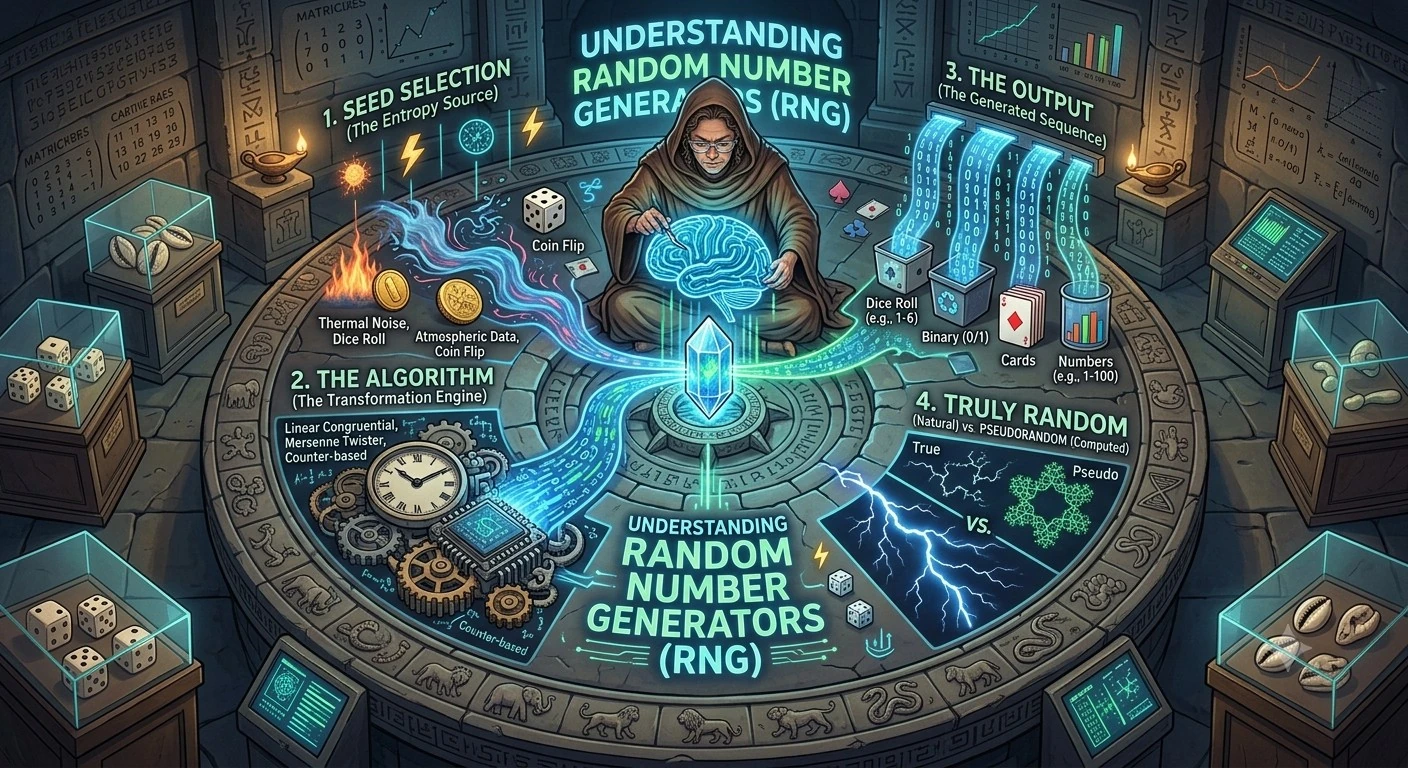
So how does a computer—a machine built entirely on strict logic and predictable instructions—generate a random result? It uses an algorithm called a Pseudo-Random Number Generator (PRNG).
A PRNG requires a starting point, known as a "seed." In modern games like Jungle Dice, this seed is usually derived from a highly unpredictable environmental factor, such as the exact millisecond of the server's system clock at the exact moment your finger touches the screen, combined with microscopic fluctuations in the CPU's temperature. The algorithm takes this complex seed and runs it through a massive, non-linear mathematical equation to spit out a number between 1 and 6.
Is it *truly* random in a philosophical sense? No, because if you somehow knew the exact mathematical formula and the exact seed state down to the millisecond, you could theoretically predict the outcome. But practically? It is entirely unpredictable and statistically flawless.
The Proof is in the Data
We don't just ask you to trust us; we trust the data. Our server infrastructure logs every single dice roll across millions of matches. When we analyze a sample size of ten million rolls, the distribution is remarkably flat. Every single number (1 through 6) appears almost exactly 16.66% of the time.
Digital dice are actually significantly *more* fair than physical dice. A physical plastic die can have microscopic imbalances in its weight distribution, rounded corners, or surface friction that subtly skew the results over time. Our PRNG algorithm has no such flaws. It is completely blind to your current score, your win streak, or your emotional state. It just does the math.
So the next time you roll three 1s in a row, don't blame the developers. Take a deep breath, blame statistical variance, and adjust your strategy. The dice are fair; it's what you do with the numbers that matters.
So why wait? Let's get playing Jungle Dice and make some people take notice!
Play a game of Jungle Dice and shock the world!
Play Jungle Dice